 Add to Chrome
 Add to Firefox
 Add to Edge
VisualThink-VLA: Visual Intermediate Reasoning for Effective and Low-Latency Vision-Language-Action Policies
May 28, 2026
Recent work has begun to equip vision-language-action (VLA) policies with explicit intermediate reasoning. In embodied control, however, textual chain-of-thought is a poor fit: irrelevant or weakly textual information can interfere with action prediction, while autoregressive text decoding adds too much latency for real-time closed-loop execution. We present VISUALTHINK-VLA, a visual intermediate-reasoning framework for accurate, low-latency VLA policies. Our bootstrapping philosophy is to guide action with effective visual thinking: VISUALTHINK-VLA bootstraps action prediction through a compact visual-evidence interface that preserves spatial precision while avoiding decoding overhead. Besides, to further improve performance and efficiency, VISUALTHINK-VLA adopts a tailored selective routing mechanism to learn the visual evidence tokens, enabling low-latency inference while preserving high-capacity specialization. We also introduce VisualEvidence-Kit, a supervision-and-audit resource centered on a VisualEvidence-Agent that constructs a 754.7k VLA instructions VisualEvidence-Set for route supervision and counterfactual faithfulness tests. Across multiple benchmarks and real-robot evaluation, VISUALTHINK-VLA achieves the highest success rate on most benchmarks while reducing the multi-second latency of reasoning-augmented baselines to the sub-second regime. For example, on BridgeData V2, it reduces step latency from 8.377,s with ECoT to 0.367,s, achieving a 22.8 times speedup.

InstructSAM: Segment Any Instance with Any Instructions
May 25, 2026In this paper, we introduce InstructSAM, a unified and streamlined framework designed for multi-instance segmentation under arbitrary instructions. We formulates instruction-driven instance segmentation as a set-structured query prediction problem and propose an explicit reasoning-to-instance query interface that elegantly bridges a vision-language model (VLM) and SAM3. Specifically, a bank of learnable instance queries is injected into the VLM and contextualized with instruction and visual information, enabling each query to serve as an instance-aware slot. A hybrid-attention mechanism further promotes interaction among these queries, visual tokens, and instruction tokens, improving instance enumeration and reducing duplicate predictions. The resulting LLM-conditioned queries are projected into SAM3's detector query space to drive accurate multi-instance segmentation in a single forward pass. This design equips SAM3 with high-level instruction understanding, compositional reasoning, and instance-level set prediction without modifying its core architecture. To support training and evaluation, we further construct Inst2Seg, a high-quality and large-scale instruction-based instance segmentation dataset and benchmark that couples free-form instructions with instance-level masks. Extensive experiments show that only 2B-scale InstructSAM achieves strong results across complex instruction-driven and phrase-level referring segmentation benchmarks, outperforming prior end-to-end methods and SAM3's agentic pipeline while enabling efficient single-pass multi-instance prediction.
CrossView Suite: Harnessing Cross-view Spatial Intelligence of MLLMs with Dataset, Model and Benchmark
May 18, 2026Spatial intelligence requires multimodal large language models (MLLMs) to move beyond single-view perception and reason consistently about objects, visibility, geometry, and interactions across multiple viewpoints. However, progress in cross-view reasoning remains limited by three major gaps: the scarcity of large-scale well-annotated training data, the lack of comprehensive benchmarks for systematic evaluation, and the absence of explicit alignment mechanisms that establish object-level consistency across views. To address these gaps, we thoroughly develop CrossView Suite across three coordinated components: CrossViewSet, CrossViewBench, and CrossViewer. Firstly, we introduce a multi-agent data engine to meticulously curate a large-scale, high-quality cross-view instruction dataset, termed CrossViewSet, covering 17 fine-grained task types with 1.6M samples. Second, we meticulously create a scene-disjoint CrossViewBench to comprehensively assess the cross-view spatial understanding capability of an MLLM, evaluating it across various aspects. Finally, we propose CrossViewer, a progressive three-stage framework for cross-view spatial reasoning in MLLMs, following a Perception -> Alignment -> Reasoning paradigm. Our method equips an adaptive spatial region tokenizer to capture fine-grained object representations, and then aligns the multi-view objects explicitly, and thus fuses aligned features for boosting the cross-view inference capacity for MLLMs. Extensive experiments and analyses show that large-scale training data, systematic evaluation, and explicit cross-view alignment are all critical for advancing MLLMs from single-view perception toward real-world spatial intelligence. The project page is available at https://github.com/Thinkirin/Crossview-Suite.
LMMs Meet Object-Centric Vision: Understanding, Segmentation, Editing and Generation
Apr 13, 2026Large Multimodal Models (LMMs) have achieved remarkable progress in general-purpose vision--language understanding, yet they remain limited in tasks requiring precise object-level grounding, fine-grained spatial reasoning, and controllable visual manipulation. In particular, existing systems often struggle to identify the correct instance, preserve object identity across interactions, and localize or modify designated regions with high precision. Object-centric vision provides a principled framework for addressing these challenges by promoting explicit representations and operations over visual entities, thereby extending multimodal systems from global scene understanding to object-level understanding, segmentation, editing, and generation. This paper presents a comprehensive review of recent advances at the convergence of LMMs and object-centric vision. We organize the literature into four major themes: object-centric visual understanding, object-centric referring segmentation, object-centric visual editing, and object-centric visual generation. We further summarize the key modeling paradigms, learning strategies, and evaluation protocols that support these capabilities. Finally, we discuss open challenges and future directions, including robust instance permanence, fine-grained spatial control, consistent multi-step interaction, unified cross-task modeling, and reliable benchmarking under distribution shift. We hope this paper provides a structured perspective on the development of scalable, precise, and trustworthy object-centric multimodal systems.
RynnBrain: Open Embodied Foundation Models
Feb 13, 2026Despite rapid progress in multimodal foundation models, embodied intelligence community still lacks a unified, physically grounded foundation model that integrates perception, reasoning, and planning within real-world spatial-temporal dynamics. We introduce RynnBrain, an open-source spatiotemporal foundation model for embodied intelligence. RynnBrain strengthens four core capabilities in a unified framework: comprehensive egocentric understanding, diverse spatiotemporal localization, physically grounded reasoning, and physics-aware planning. The RynnBrain family comprises three foundation model scales (2B, 8B, and 30B-A3B MoE) and four post-trained variants tailored for downstream embodied tasks (i.e., RynnBrain-Nav, RynnBrain-Plan, and RynnBrain-VLA) or complex spatial reasoning tasks (i.e., RynnBrain-CoP). In terms of extensive evaluations on 20 embodied benchmarks and 8 general vision understanding benchmarks, our RynnBrain foundation models largely outperform existing embodied foundation models by a significant margin. The post-trained model suite further substantiates two key potentials of the RynnBrain foundation model: (i) enabling physically grounded reasoning and planning, and (ii) serving as a strong pretrained backbone that can be efficiently adapted to diverse embodied tasks.
MAU-GPT: Enhancing Multi-type Industrial Anomaly Understanding via Anomaly-aware and Generalist Experts Adaptation
Jan 31, 2026As industrial manufacturing scales, automating fine-grained product image analysis has become critical for quality control. However, existing approaches are hindered by limited dataset coverage and poor model generalization across diverse and complex anomaly patterns. To address these challenges, we introduce MAU-Set, a comprehensive dataset for Multi-type industrial Anomaly Understanding. It spans multiple industrial domains and features a hierarchical task structure, ranging from binary classification to complex reasoning. Alongside this dataset, we establish a rigorous evaluation protocol to facilitate fair and comprehensive model assessment. Building upon this foundation, we further present MAU-GPT, a domain-adapted multimodal large model specifically designed for industrial anomaly understanding. It incorporates a novel AMoE-LoRA mechanism that unifies anomaly-aware and generalist experts adaptation, enhancing both understanding and reasoning across diverse defect classes. Extensive experiments show that MAU-GPT consistently outperforms prior state-of-the-art methods across all domains, demonstrating strong potential for scalable and automated industrial inspection.
Unified Personalized Understanding, Generating and Editing
Jan 11, 2026Unified large multimodal models (LMMs) have achieved remarkable progress in general-purpose multimodal understanding and generation. However, they still operate under a ``one-size-fits-all'' paradigm and struggle to model user-specific concepts (e.g., generate a photo of \texttt{<maeve>}) in a consistent and controllable manner. Existing personalization methods typically rely on external retrieval, which is inefficient and poorly integrated into unified multimodal pipelines. Recent personalized unified models introduce learnable soft prompts to encode concept information, yet they either couple understanding and generation or depend on complex multi-stage training, leading to cross-task interference and ultimately to fuzzy or misaligned personalized knowledge. We present \textbf{OmniPersona}, an end-to-end personalization framework for unified LMMs that, for the first time, integrates personalized understanding, generation, and image editing within a single architecture. OmniPersona introduces structurally decoupled concept tokens, allocating dedicated subspaces for different tasks to minimize interference, and incorporates an explicit knowledge replay mechanism that propagates personalized attribute knowledge across tasks, enabling consistent personalized behavior. To systematically evaluate unified personalization, we propose \textbf{\texttt{OmniPBench}}, extending the public UnifyBench concept set with personalized editing tasks and cross-task evaluation protocols integrating understanding, generation, and editing. Experimental results demonstrate that OmniPersona delivers competitive and robust performance across diverse personalization tasks. We hope OmniPersona will serve as a strong baseline and spur further research on controllable, unified personalization.
AnyMS: Bottom-up Attention Decoupling for Layout-guided and Training-free Multi-subject Customization
Dec 29, 2025Multi-subject customization aims to synthesize multiple user-specified subjects into a coherent image. To address issues such as subjects missing or conflicts, recent works incorporate layout guidance to provide explicit spatial constraints. However, existing methods still struggle to balance three critical objectives: text alignment, subject identity preservation, and layout control, while the reliance on additional training further limits their scalability and efficiency. In this paper, we present AnyMS, a novel training-free framework for layout-guided multi-subject customization. AnyMS leverages three input conditions: text prompt, subject images, and layout constraints, and introduces a bottom-up dual-level attention decoupling mechanism to harmonize their integration during generation. Specifically, global decoupling separates cross-attention between textual and visual conditions to ensure text alignment. Local decoupling confines each subject's attention to its designated area, which prevents subject conflicts and thus guarantees identity preservation and layout control. Moreover, AnyMS employs pre-trained image adapters to extract subject-specific features aligned with the diffusion model, removing the need for subject learning or adapter tuning. Extensive experiments demonstrate that AnyMS achieves state-of-the-art performance, supporting complex compositions and scaling to a larger number of subjects.
RynnEC: Bringing MLLMs into Embodied World
Aug 19, 2025We introduce RynnEC, a video multimodal large language model designed for embodied cognition. Built upon a general-purpose vision-language foundation model, RynnEC incorporates a region encoder and a mask decoder, enabling flexible region-level video interaction. Despite its compact architecture, RynnEC achieves state-of-the-art performance in object property understanding, object segmentation, and spatial reasoning. Conceptually, it offers a region-centric video paradigm for the brain of embodied agents, providing fine-grained perception of the physical world and enabling more precise interactions. To mitigate the scarcity of annotated 3D datasets, we propose an egocentric video based pipeline for generating embodied cognition data. Furthermore, we introduce RynnEC-Bench, a region-centered benchmark for evaluating embodied cognitive capabilities. We anticipate that RynnEC will advance the development of general-purpose cognitive cores for embodied agents and facilitate generalization across diverse embodied tasks. The code, model checkpoints, and benchmark are available at: https://github.com/alibaba-damo-academy/RynnEC
EOC-Bench: Can MLLMs Identify, Recall, and Forecast Objects in an Egocentric World?
Jun 05, 2025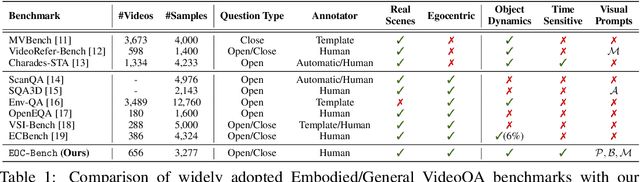
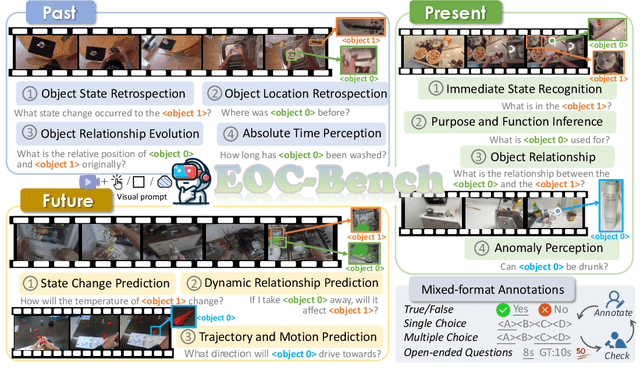
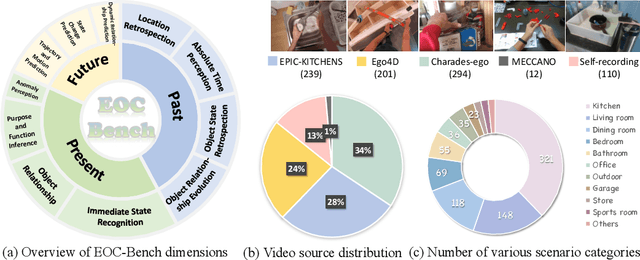
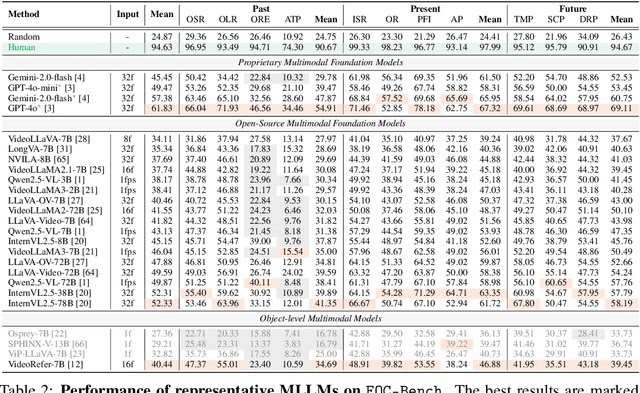
The emergence of multimodal large language models (MLLMs) has driven breakthroughs in egocentric vision applications. These applications necessitate persistent, context-aware understanding of objects, as users interact with tools in dynamic and cluttered environments. However, existing embodied benchmarks primarily focus on static scene exploration, emphasizing object's appearance and spatial attributes while neglecting the assessment of dynamic changes arising from users' interactions. To address this gap, we introduce EOC-Bench, an innovative benchmark designed to systematically evaluate object-centric embodied cognition in dynamic egocentric scenarios. Specially, EOC-Bench features 3,277 meticulously annotated QA pairs categorized into three temporal categories: Past, Present, and Future, covering 11 fine-grained evaluation dimensions and 3 visual object referencing types. To ensure thorough assessment, we develop a mixed-format human-in-the-loop annotation framework with four types of questions and design a novel multi-scale temporal accuracy metric for open-ended temporal evaluation. Based on EOC-Bench, we conduct comprehensive evaluations of various proprietary, open-source, and object-level MLLMs. EOC-Bench serves as a crucial tool for advancing the embodied object cognitive capabilities of MLLMs, establishing a robust foundation for developing reliable core models for embodied systems.